Awkward words & their worlds
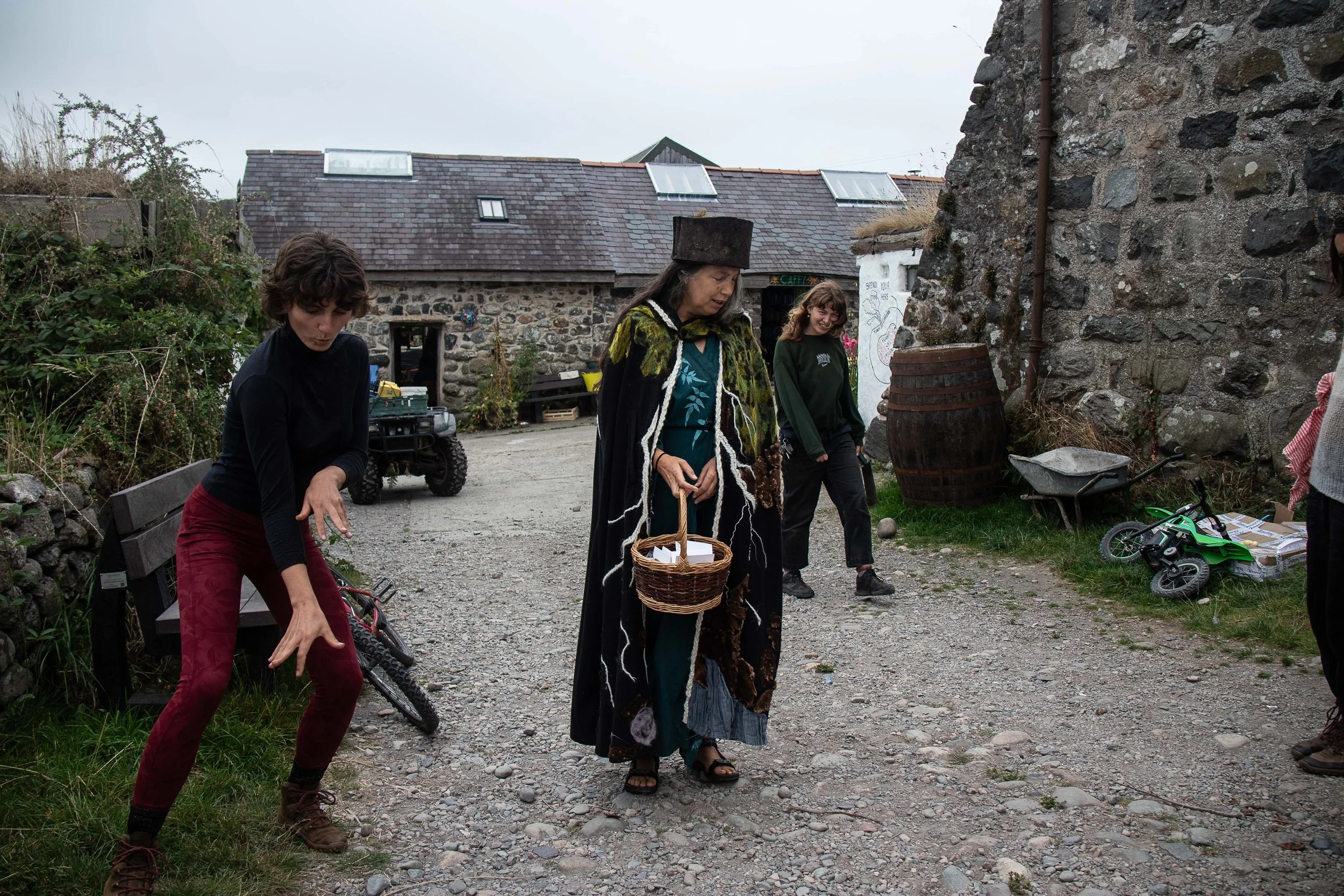
Zoë, Emily a Lotti - sesiwn Fforiad Pridd yn Henbant.
Reflections on Iaith y Pridd by Lotti Davies
One thing particularly stayed with me from our third Iaith y Pridd session, Fforiad Pridd, An Exploration of Soil (14.8.26).
The moment occurred when we were in the Fferm Henbant classroom and I was reading Gwerful Machain's windswept poem about walking across Mynydd Manod. As our creative translator of the session, Zoë had been dancing expressively to the swinging storm of the poem, beautifully re-interpreting these Welsh words with her body.
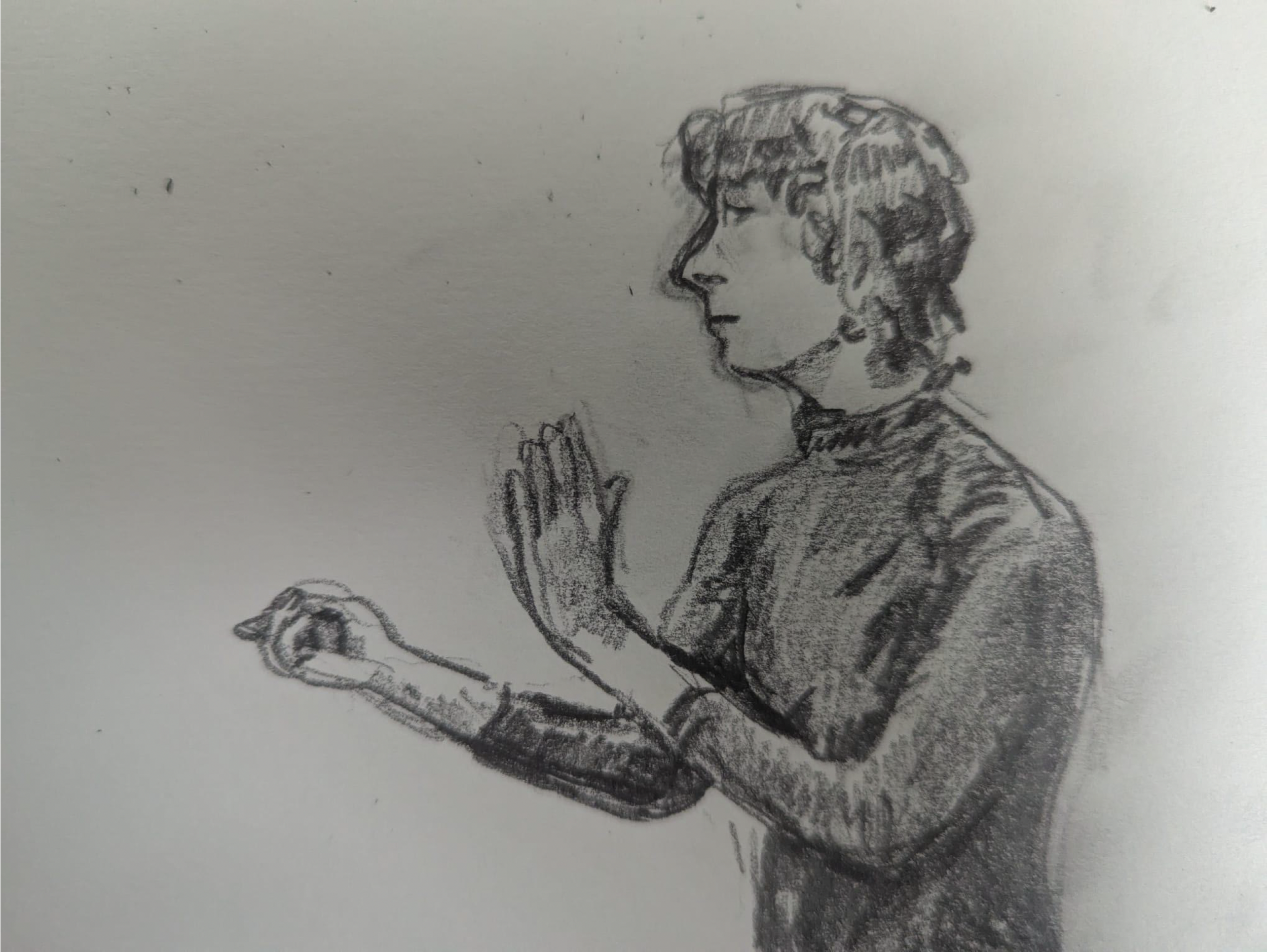
See: facial expressions and hands moving like rain
These moments were beautiful but what stayed with me most was the contrast with the stillness after; my momentary confusion when I looked at her on my left and she just stood there while I read the English version of the poem.
I don't feel totally comfortable with words; they are a big part of this social minefield. I notice how languages - and people’s expression of them, responses to them - can be part of a process of making social hierarchies: who is more intelligent? Who is better educated? Who is quieter? Who is from where? Whose words are listened to?
When I am tired after a night in the pub or cold from swimming outside, words - particularly Cymraeg - are the first thing to get cognitively muddled in my mouth. There is a shame in being wrong or saying something out of place. One of my Spotify playlists is titled 'nonverbal' - something to soothe me when words feel too much.

That is not to say that I don't think words aren’t wonderous, beautiful creations. While acknowledging that language does not belong to humans alone [1], I like to think about how words orient humans to the world, how they are enrolled in the process of conjuring relationships like some silvery spiderwebs that weave (sometimes) common meaning. I am interested in the relationships between words and bodies, between bodies and environments. All that ecological, soupy mess of wondrous relations.[2] How does something so patterned and refined somehow emerge out of these shared learned sounds? What even is this language really?
Sometimes, amongst all this loudness, the silence around words is the most insightful. It's funny how I often focus on connection with language (showing my romantic tendencies perhaps, one that fits with a general ethos of land connection in permaculture/agroecology movements) but what about words that disconnect? That create moments of awkwardness? This is why I think that moment where Zoë stopped moving hit me so much. In Zoë’s stillness, in her nonperformance for the English poem, lay her refusal to play with the dominant language of the farm.[3]
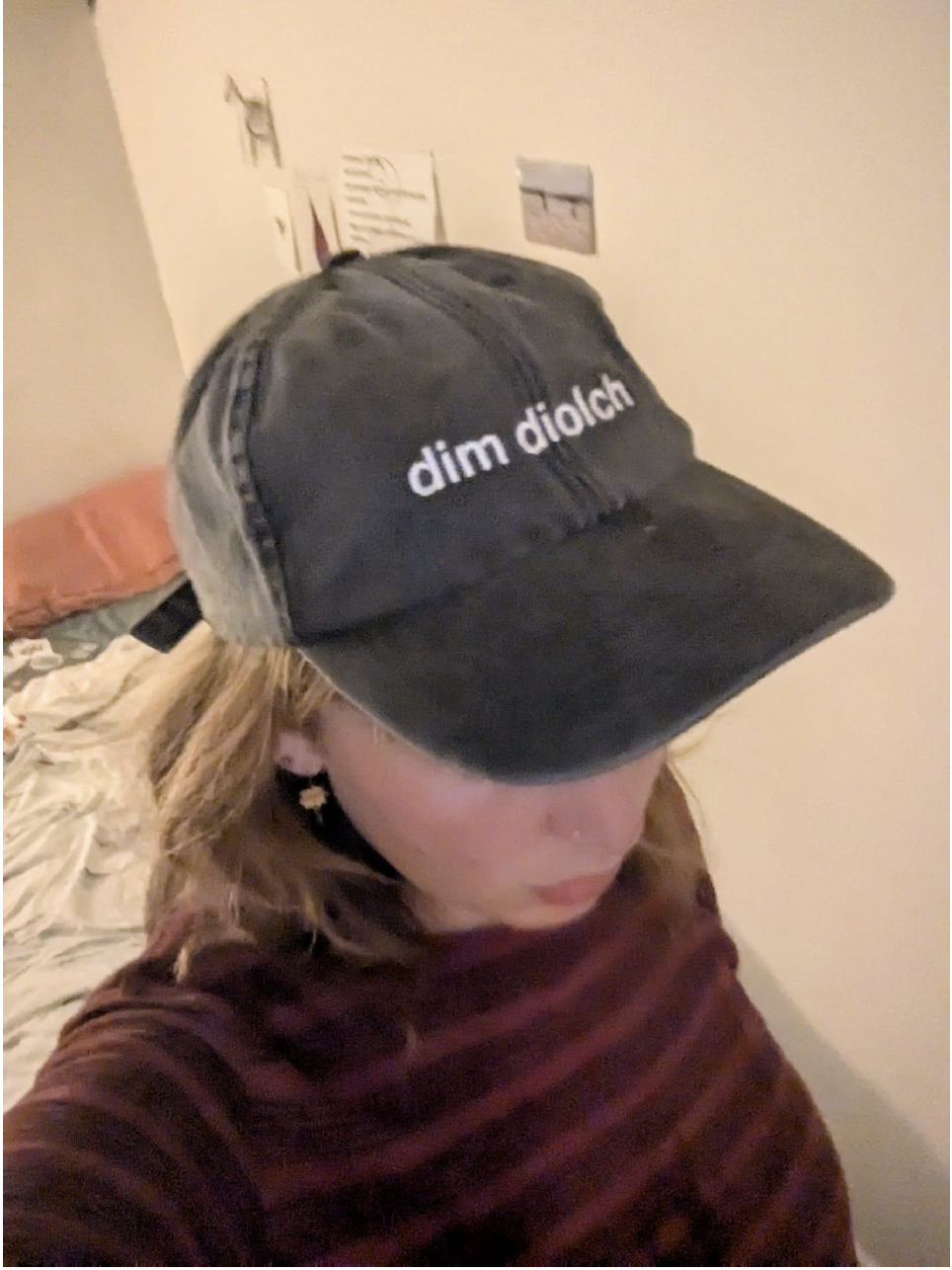
See: me wearing a ‘dim diolch’ hat
At this moment, by not speaking Welsh, there was a failure of the poem to connect to a certain kind of Welshness. This is not to say that English is inherently socially disconnecting and Welsh is inherently connecting but there is something in here about the minutiae of social dynamics that is worth noticing. It is about how those of a minority language often switch to English to accommodate others within spaces such as permaculture farms in Wales. It is about acknowledging whose comforts are being repeatedly accommodated. It is about someone telling me that they feel tired of having to explain how a local town is pronounced to people that live here again.
As someone who spends time in both Welsh and English first language spaces, I am acutely aware of the invisible thresholds which make it more acceptable to speak Welsh in some spaces rather than others. I notice how the general feeling of the room might become tense when the social norm isn't obeyed. This kind of disruption feels anxiety inducing. I feel a little worried when there is a possibility of a moment of awkwardness during Iaith yn y Pridd, that someone might feel uncomfortable.
There is also a gendered aspect of my unease with friction in social dynamics around language. Sarah Ahmed writes about the tendency to socialise women to please and manage people's emotions to ‘keep the peace’. Those who disrupt smoothness can be villainised and stereotyped - think the ‘angry black woman’ or the ‘feminist killjoy’.[4] Lauren Berlant uses the phrase ‘bourgeois affective self-management’ to describe the ways modern liberal subjects manage their emotions for maximal social success under capitalism. In other words: repressing uncomfortable emotions to maintain social comfort is part of the process which maintains structures of repression. (p.s. it is also fucking exhausting.[5]
With regards to Cymraeg, I therefore think it's important to create spaces of staying with discomfort without alienating people. It is also important to recognise that some Welsh speakers do not feel comfortable within English-speaking spaces and vice versa. In fact everyone has a unique and complicated relationship to the language(s) in the room.
The fact that I have written this essay in English first has a story: the Anglicisation of my dads side of the family in Conwy (or Conway, as my family calls it), the middle-class mobility of my father to London where he met my mother, the difficulty my mother has had to find time to learn welsh amongst raising kids and earning money, being sent to an English school for a ‘better education’, etc, etc. My Dad’s grandmother went to work as a nurse in Liverpool from Trawsfynydd during the second world war and could not speak English. Now, I am the only person out of my four cousins who speaks Welsh at least once a week and even then I feel like an imposter to the language.
The politics of small moments in the everyday matters. They are often indicative of wider patterns, or can be abnormalities that may build towards change. Sometimes a smooth exchange is hiding something. A disjuncture in a moment can be clarifying.
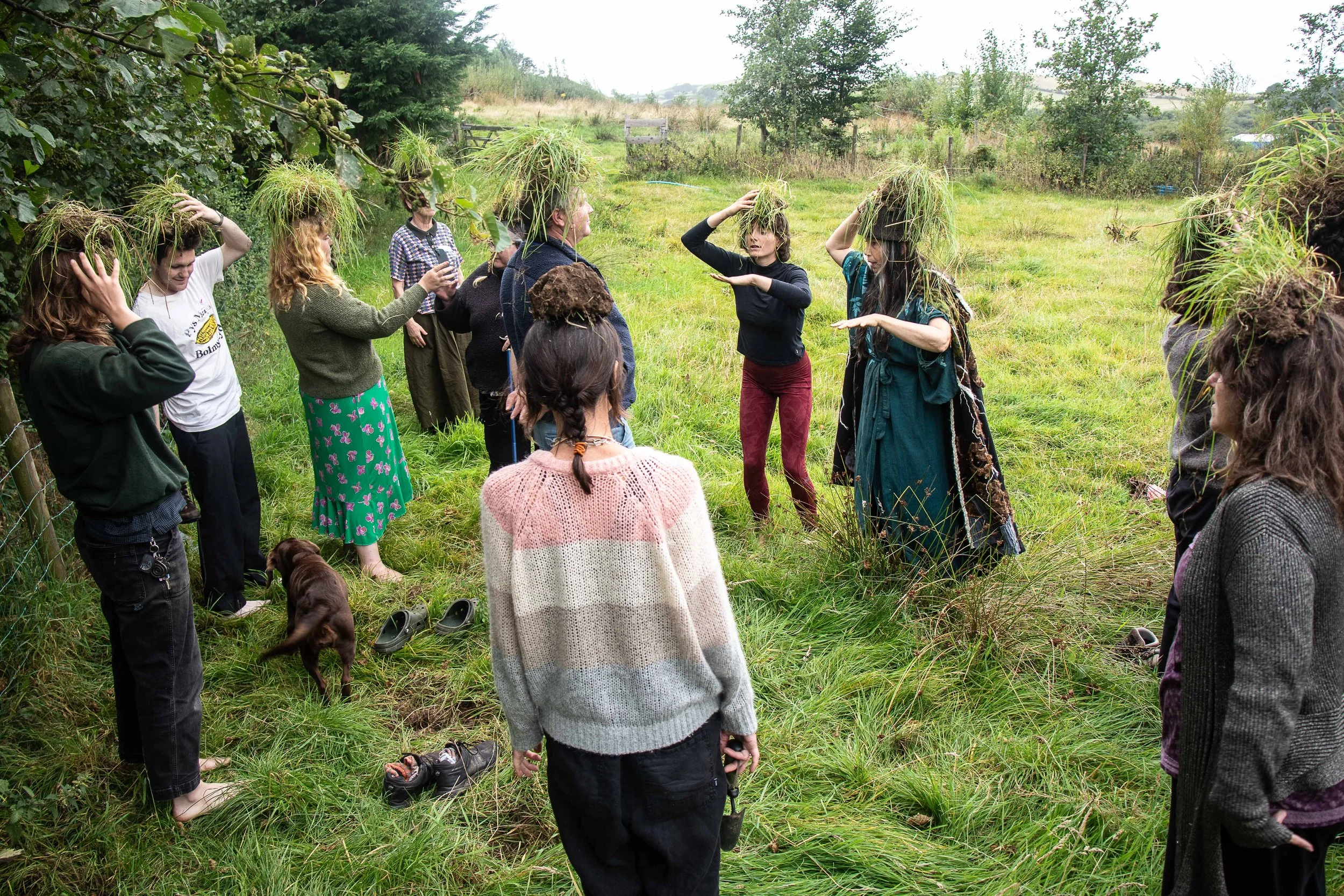
See: Emily’s walking soil meditation. Click on the image to see a video of the session.
Yet, problems of language cannot be solved in one room, even if everyone pledged to take up Welsh at that Iaith yn y Pridd session. Echoing the writer Llinos Anwyl [6], language change happens when material conditions change. For Llinos, language revival is not about how Welsh has a unique form of land connection, how certain words might become part of the branding of Wales as a uniquely mythological-ecological place. But rather about making conditions for local people more liveable (or more regenerative, as Henbant might say). In terms of landwork of the likes of alternative growing movement, this might look like questions of: how to get local young people to have easier routes into paid landwork? To have access to land and housing and financial security? How address food injustice in the forms of gaps in access and knowledge around food in North Wales? How to make it so that educated young people are not forced to choose to move elsewhere if they desire career prospects? How can jobs in the local foundational economy - things like growing, care work, and community work be valued, secure, and rewarded well?
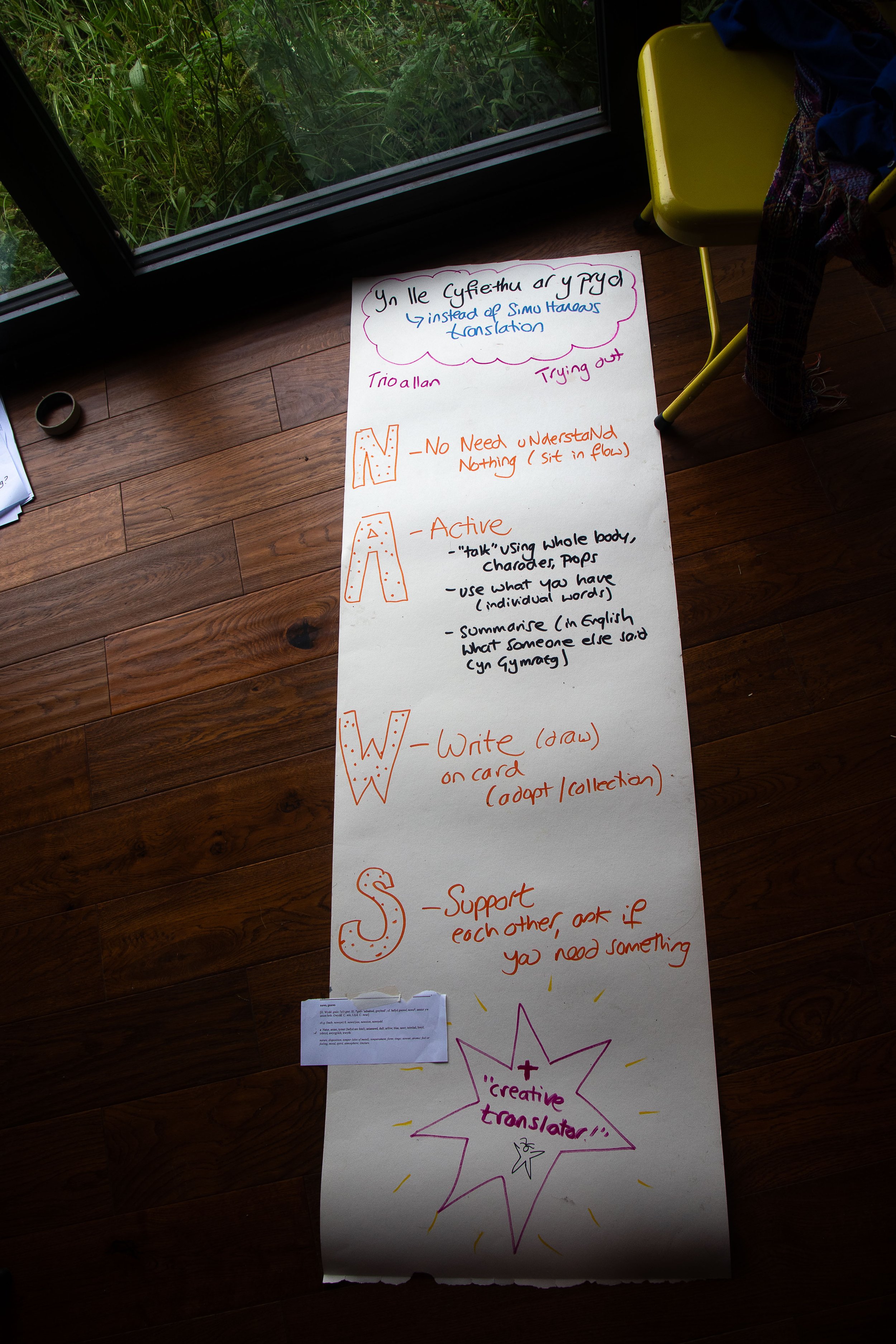
At the same time, I think feeling a little discomfort and staying with not knowing is a valuable part of disrupting norms around which spaces certain languages dominate. It is drawing attention to moments that not everyone notices like when Zoë doesn’t dance. Maybe its staying more with feelings that arise when you put a sod of earth on your head and walk around a field like we did with Emily at the start of the session (see below). I think valuable learning exchanges happen when there is more puncturing of Welsh/English, learner/speaker boundaries, to create a spaces that stay with imperfection, that acknowledges people’s different discomforts and difficult feelings. Not to run away but to build bridges in always awkward, funny and faulty ways. [6]
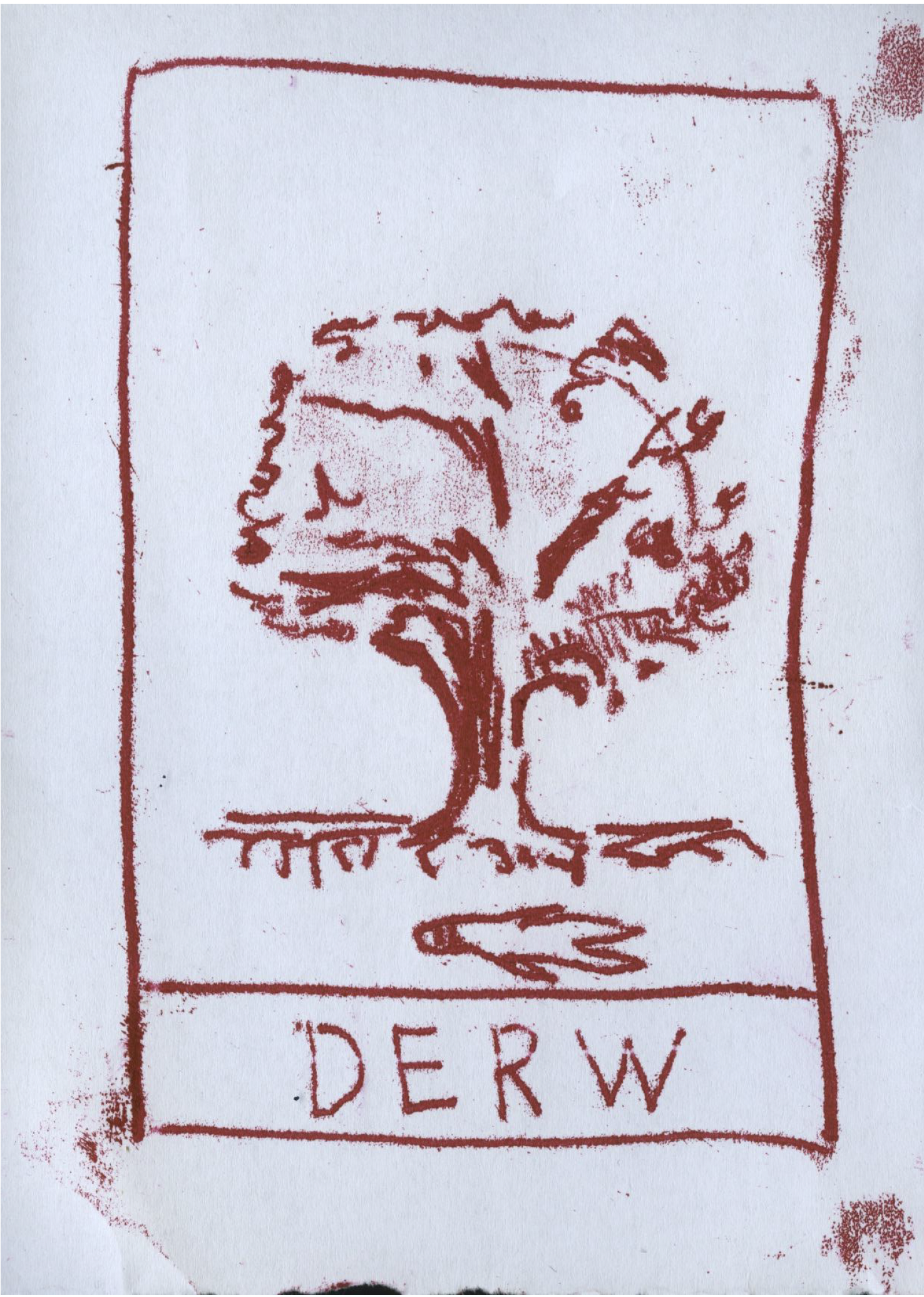
See: Derw Tarot card made by me. DERW INVITES YOU TO STAY WITH THE NOT KNOWING!!
Footnotes
1 I mean there is an infinite world here, literally. Take birdsong for instance:
https://www.manchester.ac.uk/about/news/scientists-discover-surprising-language-shortcuts-in-birdsong--just-like-humans/ Humans really know so little about this! I recommend James Bridle’s ‘Ways of Being’ on this.
2 See Ursula Le Guin. Carrier bag theory of fiction.
3 Zoë's non-responsiveness makes me think about a whole politics of refusal which is rooted in the experience of marginalised peoples. Audra Simpson, a member of the Kahnawà:ke Mohawk Nation,talks about the refusal of Mohawk people to adopt a US passport.
https://www.dukeupress.edu/Mohawk-Interruptus. See also:https://journal.culanth.org/index.php/ca/article/view/ca31.3.01/367
4 See Sarah Ahmed (2010) Happy Objects.
5 https://pmc.ncbi.nlm.nih.gov/articles/PMC7980266/
6 https://llinos.substack.com/p/learning-welsh-is-what-solidarity I adore this substack!
Mae Iaith y Pridd gan Carreg Creative yn dod â phobl ynghyd o ddwy gymuned, sef Utopias Bach a Fferm Henbant – staff, trainees, ymwelwyr, gwirfoddolwyr, cymdogion, cwsmeriaid – dros 9 mis (Ebrill 2026 - Mawrth 2027) yn Fferm Henbant, Clynnog Fawr.
Dan ni’n darganfod sut y gall ein perthynas â chymreictod â Cymraeg newid dros gylch blynyddol ar Fferm Henbant, drwy sylwi, tyfu, dysgu a chreu gyda'n gilydd.
//
Iaith y Pridd (Language of the Soil) by Carreg Creative is bringing together people from two communities- Utopias Bach and Fferm Henbant - staff, trainees, visitors, volunteers, neighbours, veg box customers - over 9 months (June 2026 - March 2027) at Fferm Henbant, Clynnog Fawr.
We are exploring how our relationship with the Welsh language and sense of place changes over an annual cycle at Fferm Henbant, by creatively noticing, growing, learning and creating together.
One of the best things has been meeting and working with people like Lotti and Zoë!
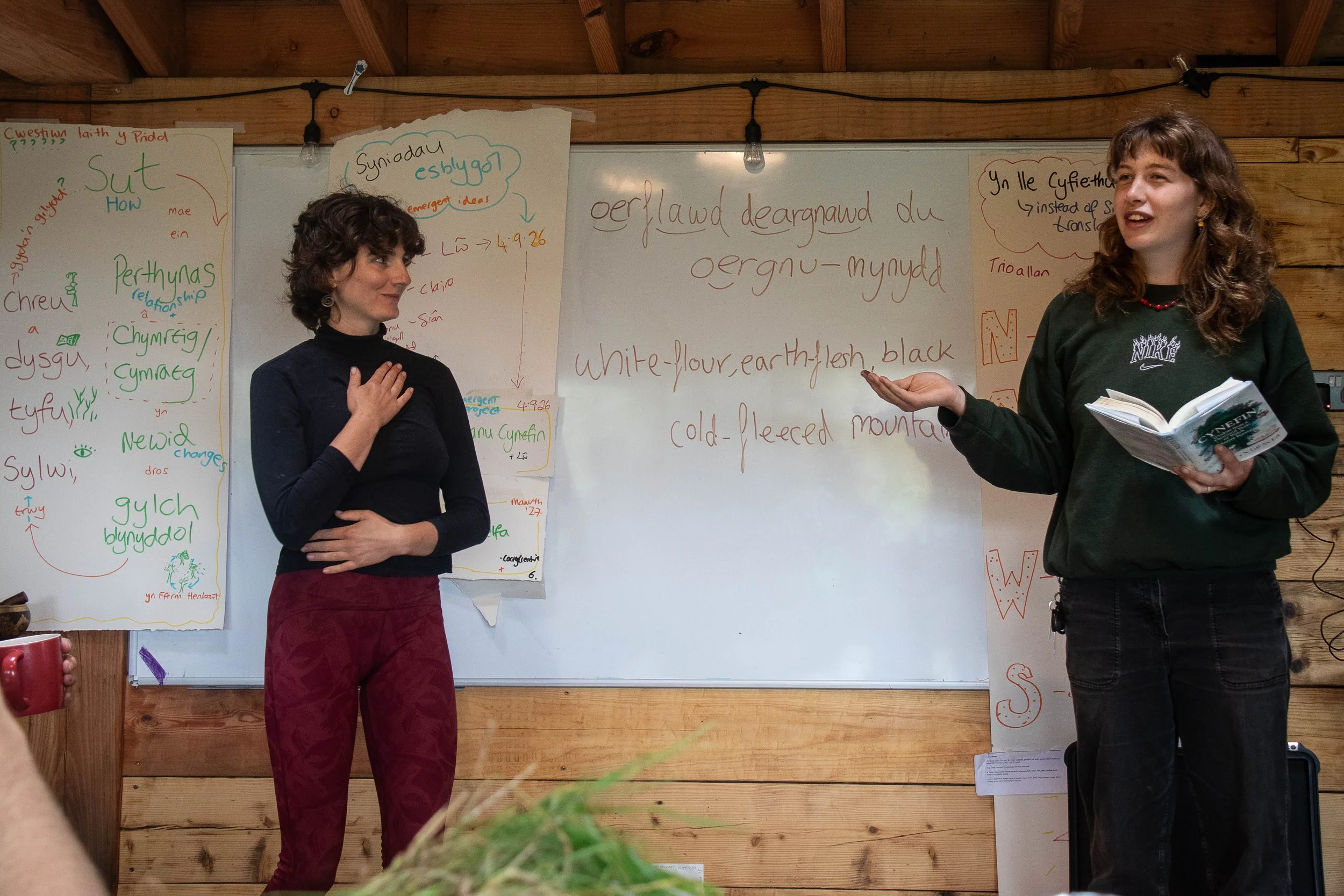
Zoë a Lotti. I weld y sesiwn mae Lotti yn siarad amdano fo, gwelir fideo yma - see video here to see the sesiwn Lotti is talking about. yn arbennig 4 minutes 30 seconds in