Invitation to Explore Weeds Permanence // Gwahoddiad i Parhau Archwilio Hirbarhad Parhad Chwyn
Date: April, 9th 2026
Dyddiad: 9fed Ebrill 2026
Time: 11am – 1pm
Amser: 11am – 1pm
Where: Relief Map of Wales at Llyn Alaw
Ble: Map Tirwedd o Gymru yn Llyn Alaw
How to get there: LL65 4TW – detailed visual directions on request. Lifts will be arranged from Bangor and Menai Bridge.
Sut i gyrraedd yno: LL65 4TW – cyfeiriad gweledol manwl ar gais. Trefnir lifftiau o Fangor a Phortwaethwy.
Cymraeg yn isod
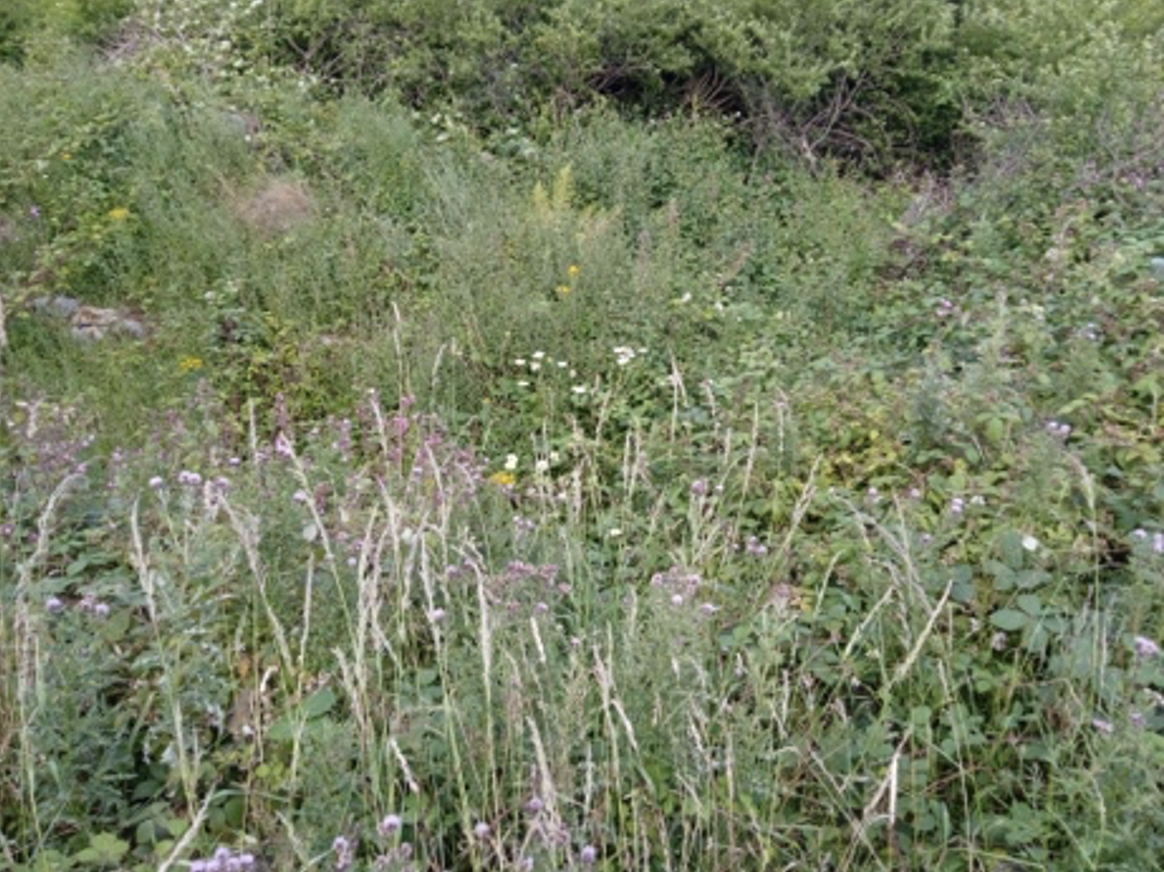
In 1987, Welsh artist Paul Davies (Beca) instigated the collaborative created of a „semi-permanent” Relief Map of Wales made of locally resourced rocks and soil at the shores of Llyn Alaw (Ynys Môn). In summer 1988 it was officially opened. 49 years later, the shore-site at Llyn Alaw has transformed and now is made home by Trees, Blackthorne, Gorse, Ivy, Farns, Mosses and many of our weedy kins
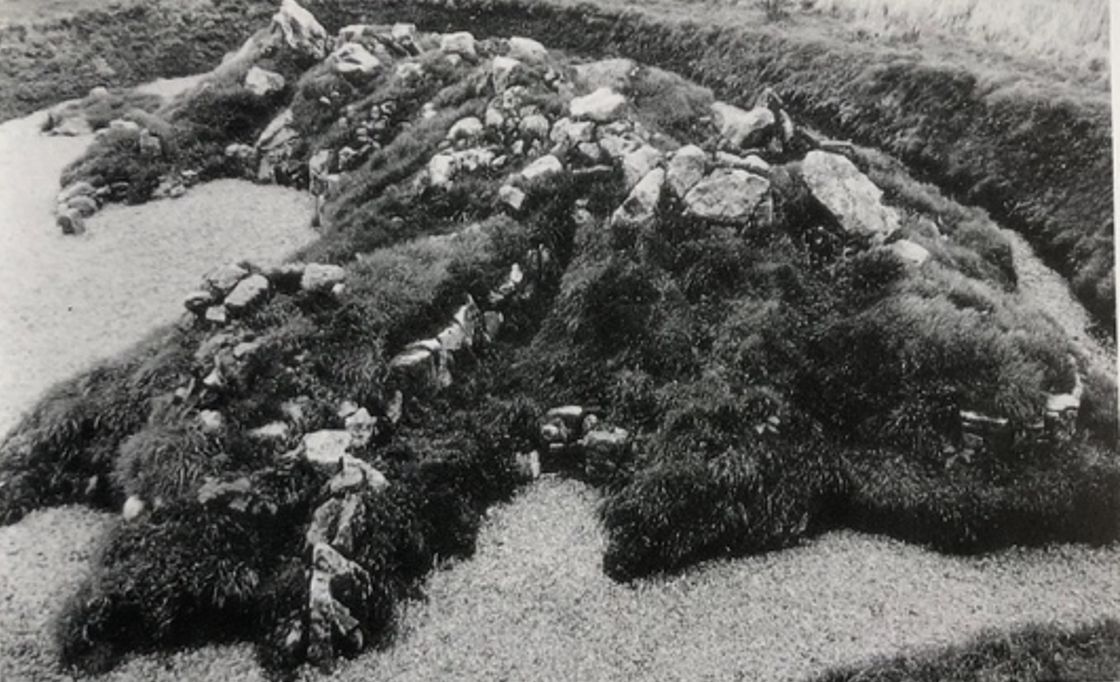
The Relief Map of Wales sculpture indeed seemed to have turned out to be “semi-permanent:” It looks like it did not remain unchanged.
Or did it?
What is semi-permanence, what is semi-permanent, particularly when referring to a sculpture set amidst a biotope as Llyn Alaw?
Does language and its etymology help us to understand what semi-permanence might mean and how we can relate to a semi-permanent Relief Map of Wales?
And does the term even discriminate against all the busy multi-species artists shaping and reshaping the Relief Map of Wales for almost 50 springs, 50 summers, winters and autumns?
Is there a level of hidden violence in our understandings and applications of permanence and semi-permanence?
I would like to invite Utopias Bach Weeds School to explore these questions through a scored visit to the site.
Interested but not sure what to expect? Here is what might be happening (subject to change):
11am: Arrival at the site, welcome and introduction at top level of the site.
11:15am: Invitations // scores distributed to guide your encounter and exploration with the site and its permanence/semi-permanence. (Invitation no obligation, you can bring your own scores).
11:30-12:15: Encountering and exploring.
12:15-12:45: Sharing
12:45: What’s next?
Visit to the site is open ended, so you can bring your lunch or a book and spend further time at the site.
Interested? What to bring? Wear appropriate footwear and clothing. Bring your own water and food if needed. Bring something to take notes, recordings – or other forms of documenting your exploration. Bring exploration tools: binocular, magnifier, graphic aids (for birds, mosses), pruner, saw, or any other tool (but anything motorist) you feel might help you in your exploration.
Accessibility of the site: Unfortunately, Welsh Water closed the Visitor Centre decades ago, and the site is not accessible. There are two barriers to cross or subvert or circumvent to access the reservoir and further natural barriers (roots sticking from the ground, thorny plants, mud) to attend to when entering the Relief Map of Wales. There are not toilets or benches but some rocks that can offer seating.
Further Information on Paul Davies’ Relief Map of Wales
Etymology
Permanent "enduring, unchanging, unchanged, lasting or intended to last indefinitely," early 15c., from Old French permanent, parmanent (14c.) or directly from Latin permanentem (nominative permanens) "remaining," present participle of permanere "endure, hold out, continue, stay to the end," from per "through" (from PIE root *per- (1) "forward," hence "through") + manere "stay" (from PIE root *men- (3) "to remain").
Semi word-forming element of Latin origin meaning "half," also loosely, "part, partly; partial, almost; imperfect; twice," from Latin semi- "half" (before vowels often sem-, sometimes further reduced to se- before m-), from PIE *semi- "half" (source also of Sanskrit sami "half," Greek hēmi- "half," Old English sam-, Gothic sami- "half").
The Old English cognate, sam-, was used in such compounds as samhal "in poor health, weakly," literally "half-whole;" samsoden "half-cooked" ('half-sodden'), figuratively "stupid" (compare half-baked); samcucu "half-dead," etymologically "half-alive" (see quick (adj.)); and the lingering survivor, sandblind "dim-sighted" (q.v.).
The Latin element was common in formations from Late Latin, as in semi-gravis "half-drunk," semi-hora "half hour," semi-mortuus "half-dead," semi-nudus "half-naked," semi-vir "half-man, hermaphrodite." The Latin-derived form in English has been active in forming native words since 15c. Semi-bousi "half-drunk" ('semi-boozy'), now obsolete, was among the earliest (c. 1400). As a noun, semi has variously been short for semi-detached house (by 1912), semi-trailer (by 1942), semi-final (by 1942).
Gwahoddiad i Parhau Archwilio Hirbarhad Parhad Chwyn
Ym 1987, cychwynnodd yr artist Cymreig Paul Davies (Beca) y gwaith cydweithredol o greu Map Rhyddhad "lled-barhaol" o Gymru wedi'i wneud o greigiau a phridd o adnoddau lleol ar lannau Llyn Alaw (Ynys Môn). Yn haf 1988 fe'i hagorwyd yn swyddogol. 49 mlynedd yn ddiweddarach, mae safle'r lan yn Llyn Alaw wedi trawsnewid ac mae bellach yn gartref i Goed, Draenen Ddu, Eithin, Eiddew, Ffermydd, Mwsoglau a llawer o'n perthnasau chwynog. Ymddengys bod cerflun Map Rhyddhad Cymru wedi troi allan i fod yn "lled-barhaol": mae'n edrych fel nad yw wedi aros yr un fath.
• Neu a wnaeth?
• Beth yw lled-barhaolrwydd, beth yw lled-barhaol, yn enwedig wrth gyfeirio at gerflun wedi'i osod yng nghanol biotop fel Llyn Alaw?
• A yw iaith a'i tharddiad yn ein helpu i ddeall beth allai lled-barhaolrwydd ei olygu a sut y gallwn uniaethu â Map Rhyddhad lled-barhaol o Gymru?
• Ac a yw'r term hyd yn oed yn gwahaniaethu yn erbyn yr holl artistiaid aml-rywogaeth prysur sy'n llunio ac yn ail-lunio Map Tirwedd Cymru am bron i 50 o wanwynau, 50 o hafau, gaeafau a hydrefau?
• A oes lefel o drais cudd yn ein dealltwriaethau a'n cymwysiadau o barhaolrwydd a lled-barhaolrwydd?
Hoffwn wahodd Ysgol Chwyn Bach Utopias i archwilio'r cwestiynau hyn trwy ymweliad â'r safle wedi'i sgorio.
 diddordeb ond ddim yn siŵr beth i'w ddisgwyl? Dyma beth allai fod yn digwydd (yn amodol ar newid):
11am: Cyrraedd y safle, croeso a chyflwyniad ar lefel uchaf y safle.
11:15am: Gwahoddiadau // sgoriau'n cael eu dosbarthu i arwain eich cyfarfyddiad ac archwiliad gyda'r safle a'i barhaolrwydd/lled-barhaolrwydd. (Dim rhwymedigaeth ar y gwahoddiad, gallwch ddod â'ch sgoriau eich hun).
11:30-12:15: Cyfarfyddiad ac archwilio.
12:15-12:45: Rhannu
12:45: Beth nesaf?
Mae ymweliad â'r safle yn ddiddiwedd, felly gallwch ddod â'ch cinio neu lyfr a threulio mwy o amser ar y safle.
 diddordeb? Beth i'w ddod?
Gwisgwch esgidiau a dillad addas.
Dewch â'ch dŵr a'ch bwyd eich hun os oes angen.
Dewch â rhywbeth i gymryd nodiadau, recordiadau - neu ffurfiau eraill o ddogfennu eich archwiliad.
Dewch ag offer archwilio: ysbienddrych, chwyddwydr, cymhorthion graffig (ar gyfer adar, mwsoglau), tociwr, llif, neu unrhyw offeryn arall (ond unrhyw beth i fodurwyr) y teimlwch a allai eich helpu yn eich archwiliad.
Hygyrchedd y safle:
Yn anffodus, caeodd Dŵr Cymru'r Ganolfan Ymwelwyr ddegawdau yn ôl, ac nid yw'r safle yn hygyrch. Mae dau rwystr i'w croesi neu eu gwyrdroi neu eu hosgoi i gael mynediad at y gronfa ddŵr a rhwystrau naturiol pellach (gwreiddiau'n sticio o'r ddaear, planhigion drain, mwd) i roi sylw iddynt wrth fynd i mewn i Fap Rhyddhad Cymru.
Nid oes toiledau na meinciau ond rhai creigiau a all gynnig seddi.
Gwybodaeth Bellach am Fap Tirwedd Paul Davies o Gymru:
https://map-of-wales.jimdosite.com/relief-map-of-wales/